You're standing on a dock in San Francisco, 1875. The air smells like salt, coal smoke, and spilled whiskey. A man you've never met buys you a drink. Tells you it's his birthday. Says there's a whole cruise leaving in an hour — free food, free booze, everyone's invited.
By morning, you're chained to a ship bound for China. And the birthday boy? He's already counting his money back on shore.
This is the story of Shanghai Kelly.
Who Was Shanghai Kelly?
The man's real name was James Kelly. Irish. Born around 1820. He came to California for the Gold Rush like thousands of others — and realized the real gold wasn't in the ground. It was in the men getting off the boats.
But before he became the most feared crimp on the Barbary Coast, Kelly was a victim himself. Fresh off the boat from Ireland, a rival crimp named Johnny Devine — so nasty they called him "Shanghai Chicken" — drugged Kelly and shipped him off to Peru. Kelly spent months stranded there, fighting his way back to San Francisco.
When he finally made it home, he didn't quit the game. He joined it.
Crimping — or shanghaiing — was the practice of kidnapping men and forcing them to work on ships. A drugged drink, a blow to the head, and you wake up at sea.

Kelly figured if you can't beat 'em, might as well be the best at it.
Why Shanghaiing Existed
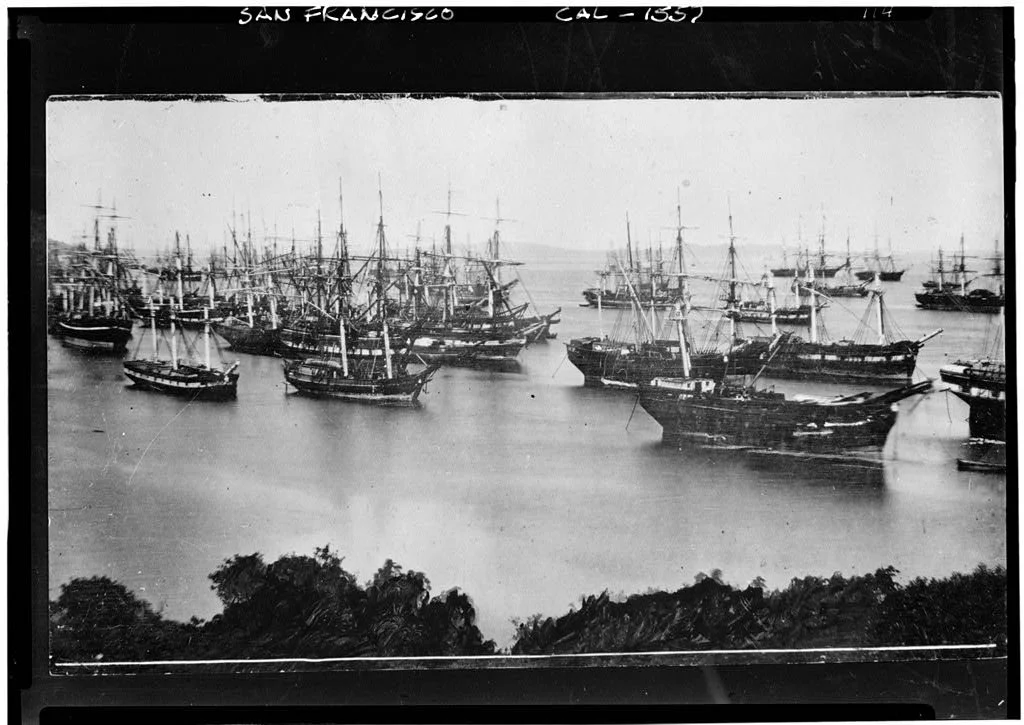
Back in the 1870s, San Francisco was a city on fire. Ships came in from all over the world — silk from China, grain from Australia, whalers from the Arctic.
But the moment a ship tied up at the dock, the crew vanished.
Can you blame them? Gold in the hills. Silver in Nevada. Land you could claim just by showing up. Why spend months eating hardtack on the ocean when you could start a new life in Gold Rush California?
So ships sat in the harbor for weeks. Sometimes months. Rotting at anchor with no one to sail them.
Desperate captains started paying cash — twenty-five, fifty, three hundred dollars a head — to anyone who could put warm bodies on their decks. Didn't matter if those bodies were currently conscious. Didn't matter if they agreed.
Kelly stepped into that gap. And he built a machine.
The Birthday Party — 1875
This is the event that made Shanghai Kelly a legend.
Three ships were stranded in San Francisco Bay. Captains were desperate — reputations so bad that even willing sailors wouldn't sign on. All three came to Kelly. They needed nearly a hundred men. Now.
Kelly rented a paddle steamship called the Goliah. Spread the word around the docks: free birthday cruise, free food, free drink, everyone welcome.
A hundred men showed up.
Kelly stood on the deck, raised his glass, and said:
"To all my faithful friends — you've made me what I am today. Now down the hatch."
Within three hours, every man on that boat was unconscious. The drinks were laced with opium, laudanum, and chloral hydrate. Kelly's crew loaded them into cargo nets and hauled them over the rails — one ship, then the second, then the third. Kelly collected payment from all three captains.
On the way back to shore, luck handed him a gift.
He came across a real shipwreck — a vessel that struck a rock off Point Concepcion, taking on water, passengers panicking. Kelly pulled alongside, rescued every soul, and broke out the real whiskey. No drugs this time. Just celebration.
By the time they docked in San Francisco, a happy drunk crowd stumbled off the gangplank. The city saw exactly what it expected: a party boat coming back from a birthday cruise.
Nobody asked a single question.
How the Operation Worked
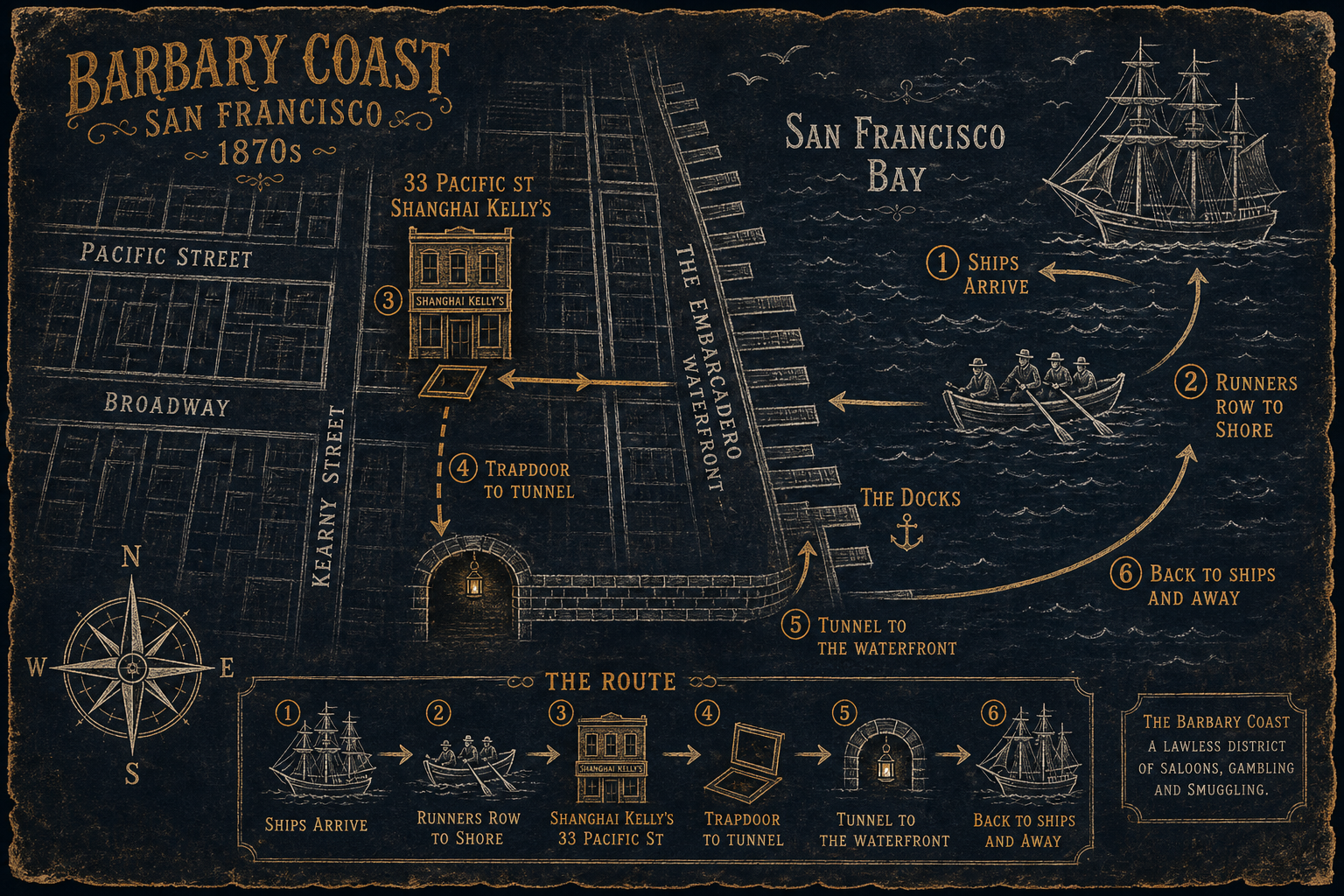
Kelly's everyday operation was built around one simple fact — his building at 33 Pacific Street sat on wooden pilings directly over San Francisco Bay. At high tide, a rowboat could pull right up underneath it.
Upstairs: a bar. Warm, lively, Kelly buying rounds and laughing louder than anyone.
Downstairs: a trapdoor.
His runners would row out to arriving ships, befriend the crew, and invite them in for "the best drink in San Francisco." Back at the bar, the drink was waiting — laced with opium and other substances. He had a signature mix called the Miss Piggott Special, named after a female crimper who ran a rival joint down the street.
He also handed out cigars laced with opium, which he called the Shanghai Smoke. Half the time a man would get hit from two directions before he finished his first drink.
When the target started going under, Kelly made a show of it. Slapped the guy on the back. Laughed: "Look at this one — can't hold his liquor!"
The crowd laughed along. Nobody asked questions.
Kelly's men carried the "drunk" out the back, through a trapdoor, down a tunnel, onto a boat waiting in the water below. The boat rowed out to a ship in the bay.
By morning, the ship was gone.
The Scale of It
In 1890 — just one year — port records show 1,168 men shanghaied out of San Francisco. Over $71,000 paid out in crimping fees. More than 400 businesses got a cut — saloons, boardinghouses, clothiers who sold the sailor his new outfit before he woke up at sea.
This wasn't a back-alley racket. It was an industry. With ledgers, receipts, and a paper trail you could follow.
The city looked the other way because too many people were making too much money.
One Victim's Story
William Davis was a cabinet-maker. A family man. He lived near the Great Salt Lake with his wife and kids.
In the mid-1870s, he came to San Francisco looking for work. He stopped at a bar on the Barbary Coast — the rough waterfront neighborhood, about six blocks of saloons, brothels, and boardinghouses where the police didn't go unless they went in force.
He had one drink.
His family didn't see him again for eight years.
Eight years. Shipped from port to port. Forced to work. Trying to survive long enough to get home.
When he finally made it back, his wife had declared him legally dead. She had remarried. His kids had grown up without him.
That's what shanghaiing actually looked like. Not an adventure story. A life erased. And it happened to hundreds of men a year.
The Law — Why It Was Legal
Kidnapping free men. Forcing them to work. Selling their labor.
That sounds like the definition of slavery.
The Thirteenth Amendment abolished slavery in 1865. But in 1897 — thirty-two years later — the United States Supreme Court ruled in Robertson v. Baldwin that shanghaied sailors were not protected by it.
Justice Henry Brown wrote the majority opinion. His reasoning?

Seamen were, in his words, "deficient in that full and intelligent responsibility for their acts that is accredited to ordinary adults."
Too stupid to deserve freedom. That was the legal logic of the highest court in the land.
That ruling kept crimping alive for another eighteen years. It wasn't until 1915 — the Seamen's Act — that shanghaiing finally became a federal crime.
Fifty years after the Thirteenth Amendment, the United States government was still arguing that some men didn't count.
What Happened to Shanghai Kelly?
Nobody knows for sure.
One story says he got shanghaied himself — again — later in life. Same way he came into the business. Loaded onto a ship. Never came back to San Francisco.
Another story says one of his own runners shot him.
Either way, the King of the Crimps didn't die in a courtroom. Didn't die in a hospital bed. He just... vanished.
Just like his victims did.
Subscribe & Listen
Ricky's Historical TidBits is a show about the events and people in history that textbooks either skip or only touch with a paragraph or two. New episodes every week — available as video, article, and podcast.