The Bankrupt "Emperor" of San Francisco: He Ruled for 21 Years
Imagine losing everything.
Your money. Your business. Your reputation. Everything you built with your own two hands.
Three years later… you walk into a newspaper office, hand the editor a single piece of paper, and calmly declare:
‘I am now Emperor of the United States.’
Instead of locking you up or laughing you out the door…
they print it. Word for word. On the front page.
And for the next twenty-one years, the entire city of San Francisco — this wild, gold-crazed, reinvent-yourself town — just… plays along.
That man was real.
That city was San Francisco at its most wonderful.
And this… is his incredible story.”
The Man Before the Crown
Joshua Abraham Norton was never meant to be a joke.
Born in London in 1818, raised in South Africa, he sailed into San Francisco late in 1849 with the Gold Rush in full roar — and he arrived with real money from his family’s estate.
Picture the city then: streets thick with mud up to your ankles, hundreds of ships abandoned in the harbor because every sailor jumped ship to chase gold, canvas tents sprouting like mushrooms, men getting rich or broke overnight. Pure chaos, pure opportunity.
Norton didn’t pan for gold. Under the name Joshua Norton & Co., he became a titan of wholesale trade — commodities, real estate, imports. He owned prime downtown corners. He ran a rice mill. And at 113 Jackson Street he operated his own cigar factory. In the 1850s, cigars were practically a second currency in San Francisco — and owning the factory put him at the very top of the social ladder.
By 1852, newspapers called him ‘a merchant of standing.’ His net worth had climbed to about two hundred fifty thousand dollars — that’s over eight million dollars in today’s money. He was living the California dream…
until one single decision wiped it all away.”
The Rice Collapse
Late 1852. China suffers famine, bans rice exports. Prices in San Francisco explode.
Norton sees his shot — and because he already owned a rice mill, this wasn’t just speculation, this was personal. He buys an entire shipment — two hundred thousand pounds of Peruvian rice — at twelve-and-a-half cents a pound. That’s twenty-five thousand dollars in 1852 money — a small fortune.
Plan: corner the market, sell high, retire rich.
Then… more ships arrive. Loaded. The market floods. Price crashes to three cents a pound. Seventy-five percent of his money — gone in days.
He fights it in court for nearly four years. Appeals, fees, heartbreak. He loses everything.
By 1856, Joshua Norton is bankrupt.
Most men would’ve slunk out of town in shame.
Norton disappeared for three quiet years…
and came back with the boldest plan of his life.”
The Proclamation
September 17, 1859.
He walks into the San Francisco Evening Bulletin office, hands the editor the paper, and says simply, ‘Print this.’
‘At the peremptory request and desire of a large majority of the citizens of these United States, I, Joshua Norton, formerly of Algoa Bay, Cape of Good Hope, and now for the last nine years and ten months past of San Francisco, California, declare and proclaim myself Emperor of these United States; and in virtue of the authority thereby in me vested, do hereby order and direct the representatives of the different States of the Union to assemble in Musical Hall of this city, on the first day of February next, then and there to make such alterations in the existing laws of the Union as may ameliorate the evils under which the country is laboring…’
Signed,
Norton I, Emperor of the United States.
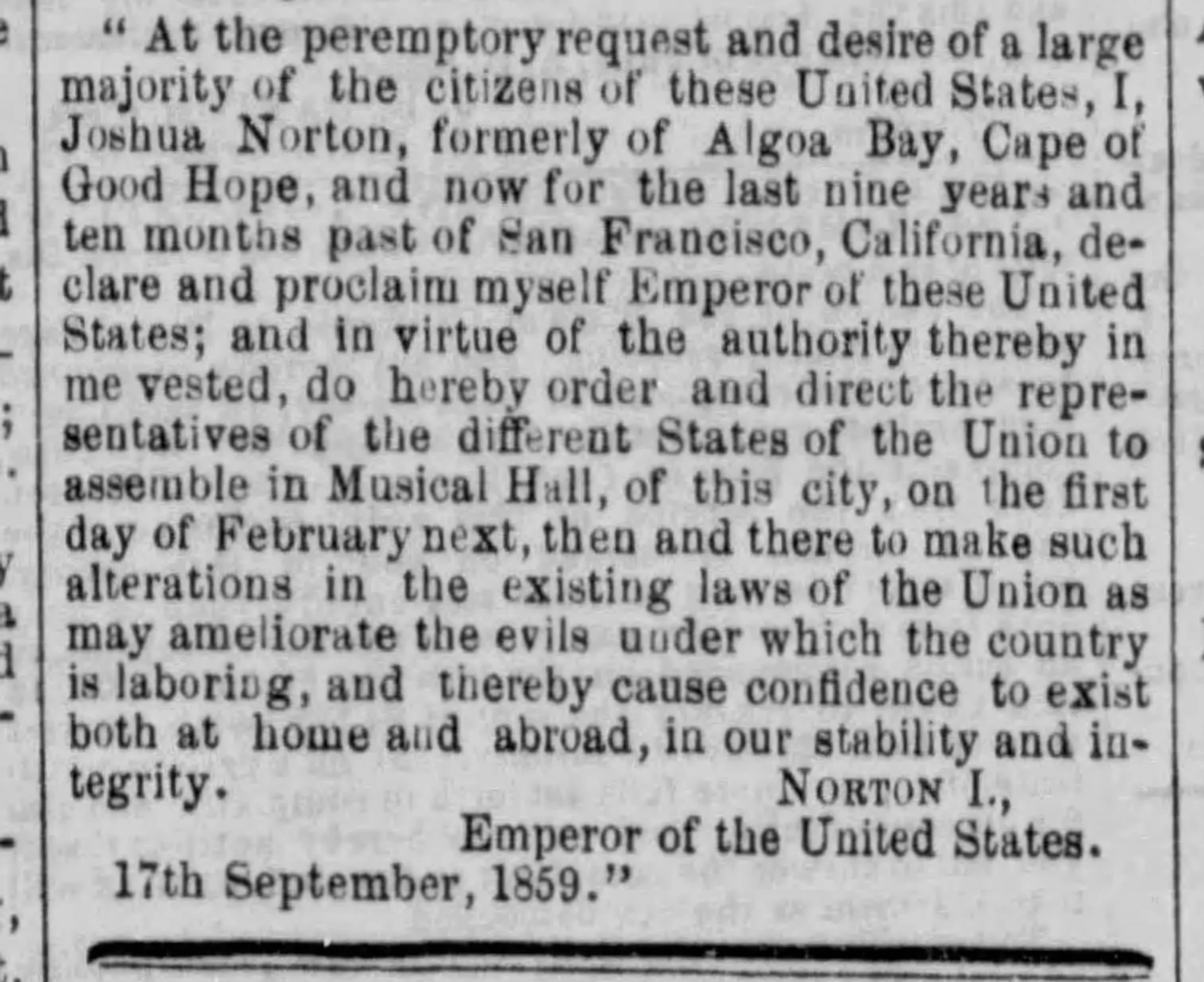
‘At the peremptory request and desire of a large majority of the citizens of these United States, I, Joshua Norton, formerly of Algoa Bay, Cape of Good Hope, and now for the last nine years and ten months past of San Francisco, California, declare and proclaim myself Emperor of these United States; and in virtue of the authority thereby in me vested, do hereby order and direct the representatives of the different States of the Union to assemble in Musical Hall of this city, on the first day of February next, then and there to make such alterations in the existing laws of the Union as may ameliorate the evils under which the country is laboring…’
Signed,
Norton I, Emperor of the United States.
No smile. No wink. He meant every word.
And they printed it. Other papers picked it up.
When nobody showed up for his national convention, he didn’t get discouraged — he simply issued another decree dissolving the Republic because the representatives were ‘too corrupt’ to meet with him.
The city read it… smiled… and decided to play along.
The Emperor’s Daily Life

He got the uniform: a secondhand blue military coat with gold epaulettes, a cavalry sword, a tall beaver hat with bright feathers or a rosette. He even mixed Union and Confederate pieces — he wanted to stay neutral so he could help heal the country.
Every single day he walked Montgomery Street like he owned it — posture perfect, sword at his side.
He lived simply in a tiny nine-by-six-foot room on the top floor of the Eureka Lodgings on Commercial Street. Rent sometimes paid by old friends.
But the city took care of the rest. After the 1867 arrest (we’ll get there), Police Chief Patrick Crowley made it an unwritten rule: every officer was to snap to attention and salute him. It wasn’t because they believed he ruled — it was to keep the peace. The people loved him so much that disrespecting the Emperor could start a riot.
Restaurant owners shouted ‘Good afternoon, Your Majesty!’ and fed him free meals — many bars gave food with every drink, and Norton made the rounds. Cigar shops — remembering the old days when he owned the factory — gave him free cigars as ‘imperial tax.’ One famous tobacco house, Sutliff’s, even accepted his bonds as payment. Merchants gave him clothes. Theaters kept the best seat open — free. He got free ferry rides… and thanks to a lifetime railroad pass from the mighty Central Pacific, he traveled whenever he pleased.
How’d he get that pass? He wanted to go to Sacramento, a ticket agent refused him. Norton issued a decree threatening to blockade the entire railroad until they showed proper respect. The directors — including Leland Stanford — quickly issued him a lifetime pass and ordered conductors to announce: ‘Make way for His Imperial Majesty, Norton I.’
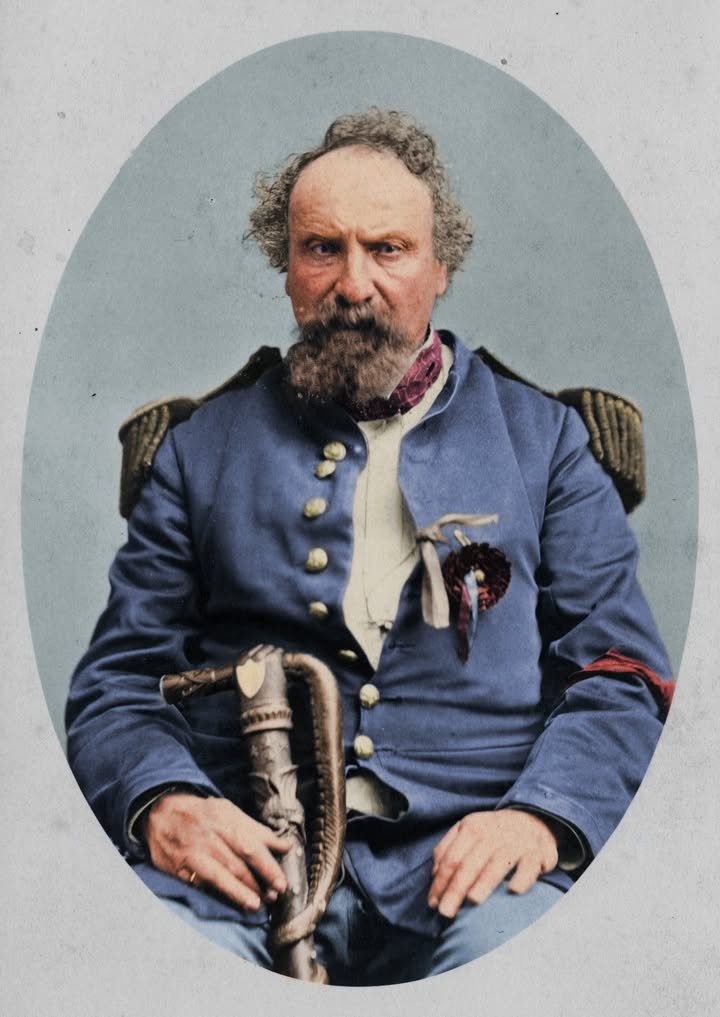
He didn’t just stay in San Francisco. He’d take the ferry to Sacramento when the legislature was in session. The politicians there actually kept a reserved chair for him right on the floor of the Senate or Assembly. He’d sit in, take notes, and later issue decrees telling them everything they were doing wrong. In December 1869 he traveled up to inspect the brand-new State Capitol building and even attended the gala ball for its inauguration. Afterward he scolded Sacramento in print for its ‘muddy streets’ and lack of a ‘first-class hotel.’
He inspected the streets like a real ruler — poking at broken sidewalks, checking cable cars, commenting on police uniforms. Afternoons he’d sit at the Mechanics Institute playing chess and talking politics with anyone who would listen.
This wasn’t madness.
This was beautiful, shared theater — and San Francisco loved being in the show.”
The Royal Companions — Bummer & Lazarus
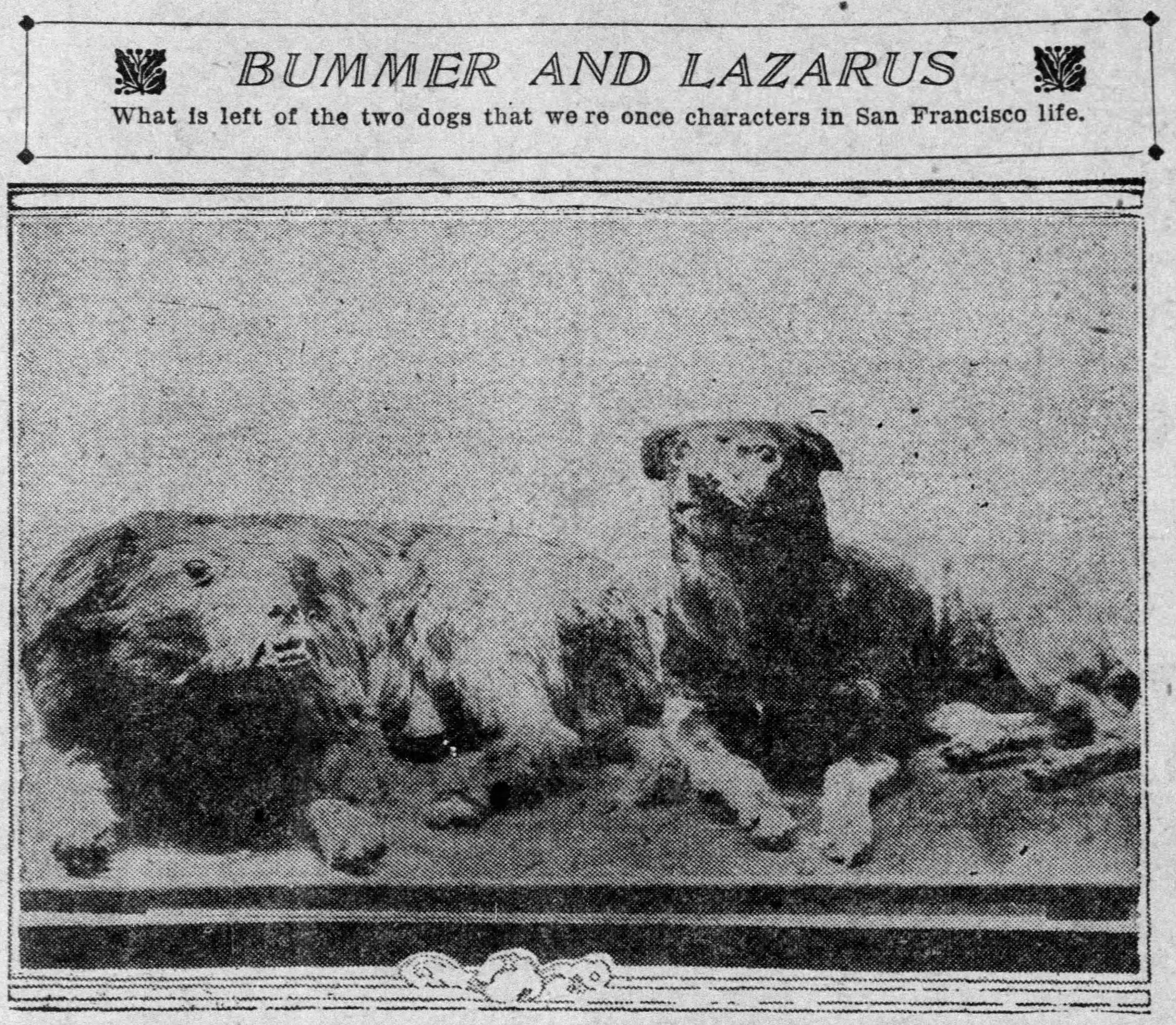
Every emperor needs a court.
The city gave Norton the two most famous stray dogs in San Francisco: Bummer and Lazarus.
Bummer was a big, tough rat-killing bulldog. One day he found a half-dead little mutt and nursed him back to life — that’s how the smaller dog got the name Lazarus. Their friendship made front-page news.
A local caricaturist named Edward Jump started drawing Norton walking proudly with his two canine subjects. Cartoons everywhere. Theaters even reserved three balcony seats — one for the Emperor… and two for the dogs.
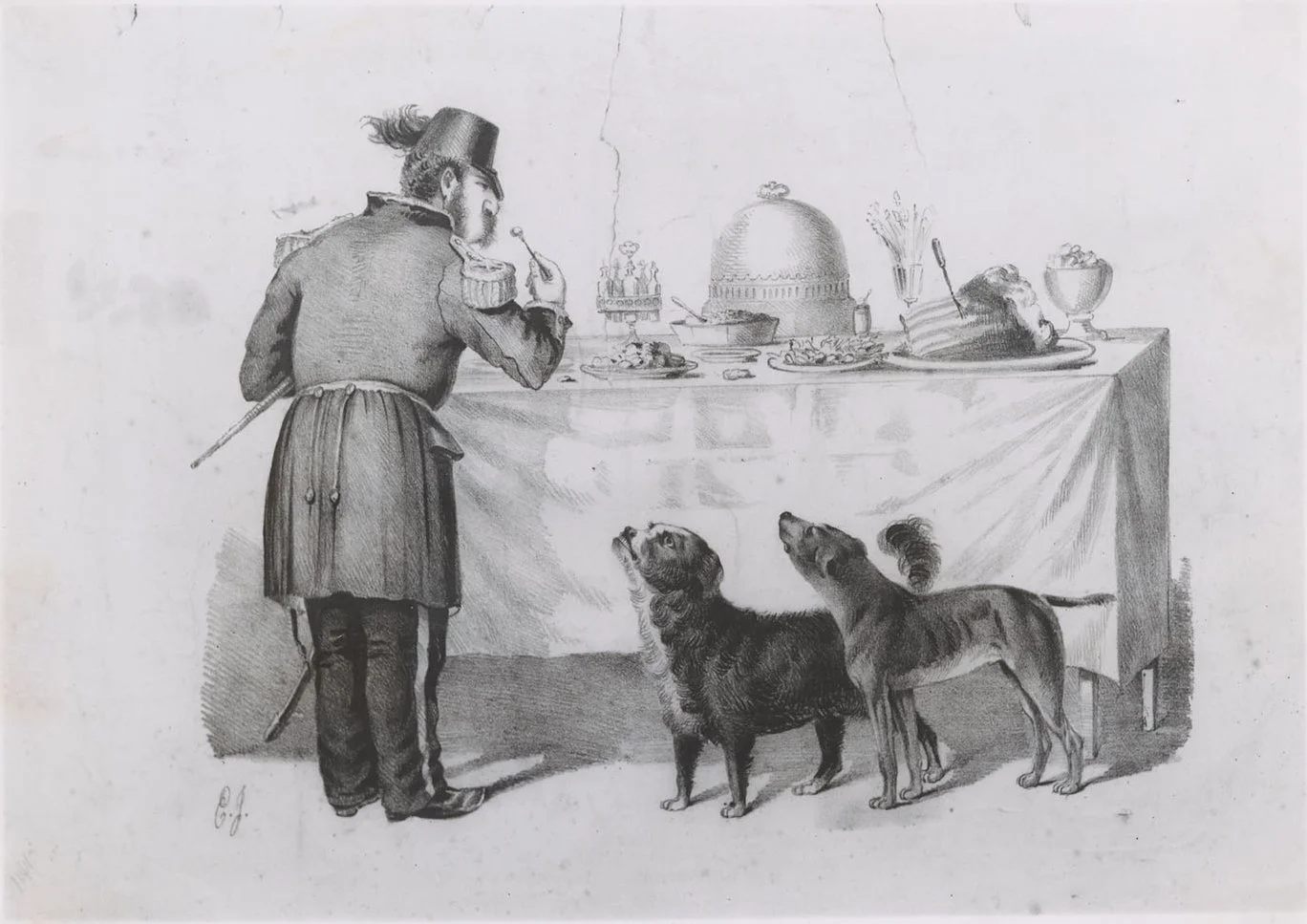
But one cartoon in 1865 went too far. Jump titled it ‘The Three Bummers’ — showing Norton waiting behind the two dogs at a free-lunch counter. In 1860s slang, a ‘bummer’ meant a moocher, a leech. Norton was furious. He stood in front of the print-shop window on Montgomery Street and gave a loud public speech denouncing the ‘low-lived’ artist. The crowd loved the drama. The cartoon became even more famous.
Truth is, they weren’t officially his pets. Norton was actually a little offended by being grouped with ‘lowly dogs.’
But the city loved the image so much that the legend stuck. It made the whole story even warmer, even more San Franciscan.”
The Civil War Emperor, Protector of Mexico & Bold Decrees
When the Civil War broke out, Norton didn’t hide. He issued hundreds of proclamations. He abolished Congress…

He banished Abraham Lincoln.

He offered a huge reward for Jefferson Davis.
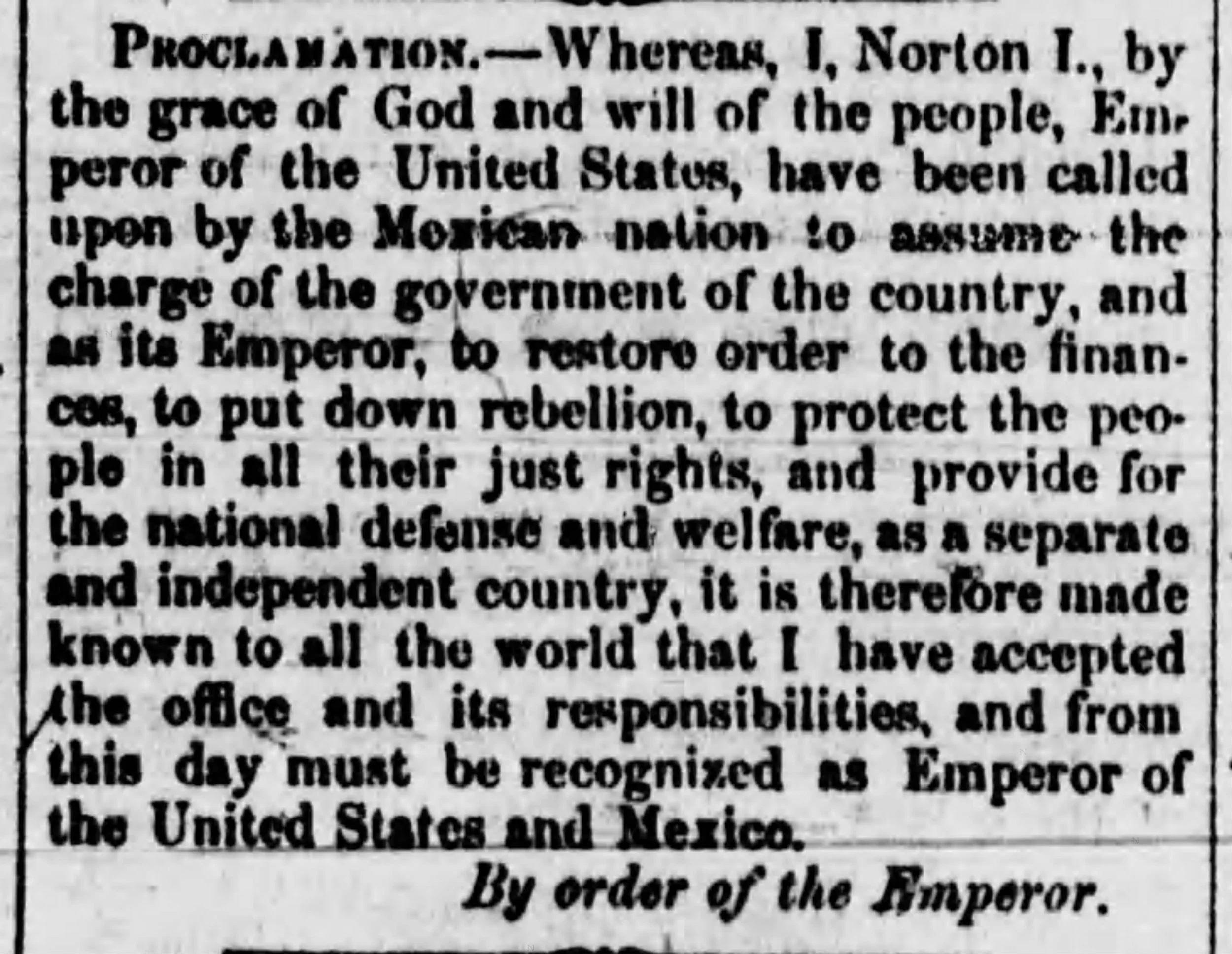
Later he added ‘Protector of Mexico’ when the French invaded.
He even started giving out little titles — ‘King for a Day’ or ‘Queen for a Day’ — to kids or anyone who looked like they needed cheering up.
And in 1869 he issued a decree calling for a massive Christmas tree in Union Square for the city’s children who might not have much at home. The city listened — and to this day, over 150 years later, San Francisco still puts up that giant tree in Union Square every December.
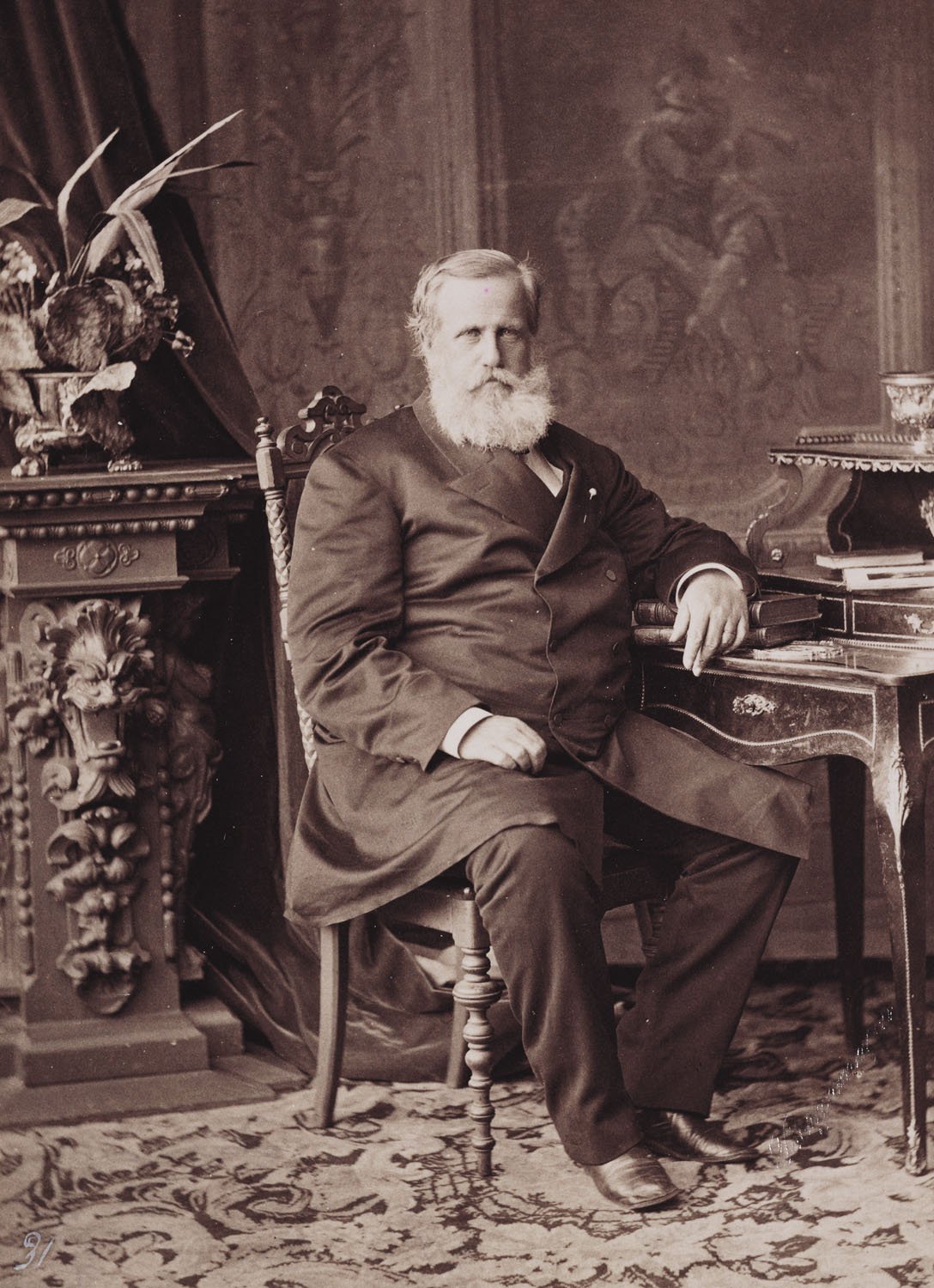
He even went international. In 1876, the real Emperor of Brazil, Dom Pedro II, visited San Francisco. Most people expected him to ignore the local ‘madman.’ Instead, the two monarchs met at the Palace Hotel. Norton was formally introduced as Emperor of the United States, and they sat and talked like equals for nearly half an hour. Norton used that meeting as proof of his legitimacy for the rest of his life.
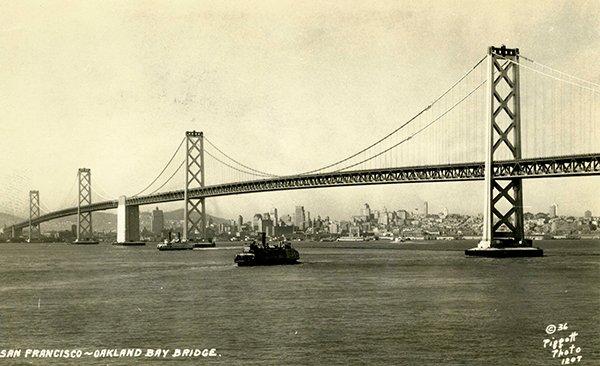
And in 1872 he decreed a suspension bridge — and even a tunnel — from Oakland to San Francisco, almost exactly where the Bay Bridge and Transbay Tube stand today.
The Arrest That Changed Everything
In 1867 a young officer named Armand Barbier arrested Norton for ‘lunacy.’
The city lost its mind. Newspapers called it an outrage. The police chief personally released him and apologized.
Norton, in his mercy, issued a full pardon to Officer Barbier.
A man with zero real power… pardoned the entire police department.
And San Francisco just smiled and said, ‘That’s our Emperor.’
Imperial Money
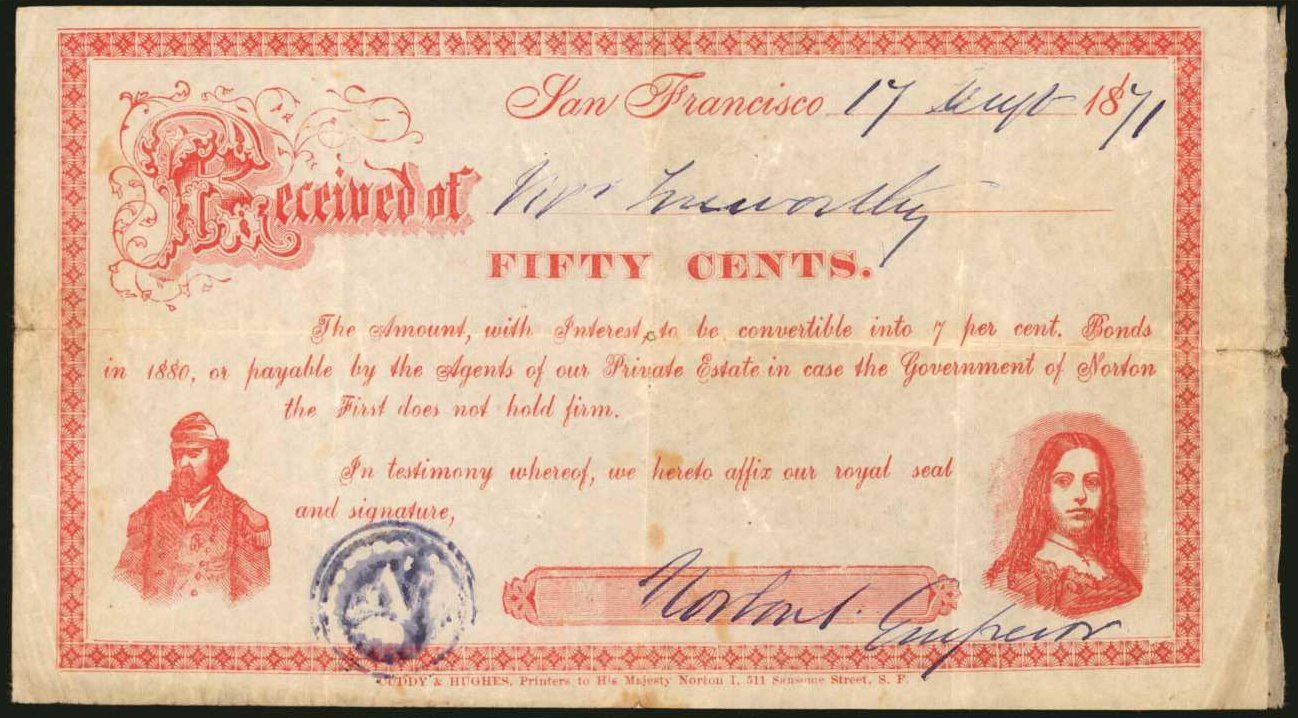
He even printed his own currency — beautiful little promissory notes: fifty cents, one dollar, five, ten. Real local printers made them. He signed every one.
Some shops actually took them for small purchases — especially the cigar shops that remembered the old days. Most people collected them as souvenirs. Today those same scraps of paper sell for thousands at auction.
His imaginary money became real — because the city wanted the story to keep going.

The Tragic Irony
In 1870 the U.S. Census taker knocked on his door at the Eureka Lodgings. When asked for his occupation, he simply said: ‘Emperor.’
The government didn’t find it funny. They marked him down as ‘insane’ in the official records. And because of that one mark on a piece of paper, the man who ‘ruled’ the United States was legally banned from ever casting a vote.
The irony is heartbreaking. He spent his days reading every newspaper, issuing decrees about how the country should be run… yet he couldn’t vote in a single election.
The End & The Legend
January 8, 1880. Cold, rainy evening.
Norton collapses on the corner of California and Dupont (now Grant) Street while on his daily walk — right at the edge of Chinatown, near Old Saint Mary’s Cathedral. He was heading to a lecture at the California Academy of Sciences. He leaned against a wall, slumped to the sidewalk, and died almost instantly. Passersby and cable-car riders saw it happen. A police officer called for a carriage to the city receiving hospital, but it was too late.
In his pocket: four dollars and seventy-five cents in cash, a few of his own unpaid Imperial bonds, a French franc, and a collection of walking sticks. They also found his ‘private correspondence’ — including a fake telegram from Tsar Alexander II of Russia congratulating him on his upcoming marriage to Queen Victoria. He truly lived in his own world until the very last second.
The city paid for everything. Businesses closed. Black mourning crepe hung in windows. Ten thousand people came to view the body lying in state. Some papers claimed thirty thousand lined the streets for the funeral procession — the legends grew because people loved him that much.
He was buried in full uniform, sword by his side.
When his remains were moved to Woodlawn Cemetery in Colma in 1934, thousands came again.
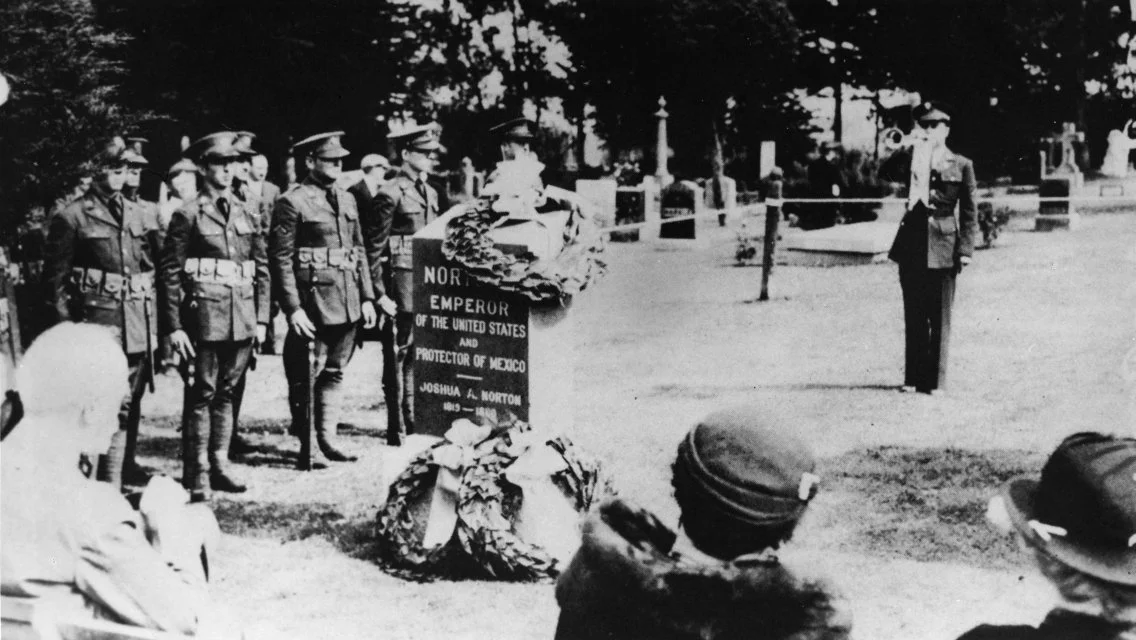
Joshua Abraham Norton lost everything a man can lose — quarter-million-dollar fortune, cigar factory, rice mill, the works.
He could’ve crawled away and disappeared.
Instead he put on the blue coat, strapped on the sword, and told San Francisco he was their Emperor.
And here’s the part that still gets me:
They went along with it.
For twenty-one years the police saluted, the restaurants fed him, the theaters saved his seat, the railroad gave him a lifetime pass, and the newspapers printed every decree.
He never commanded an army, never collected a tax, never hurt a soul.
But he walked Montgomery Street like he owned the damn place, and the whole city decided — why the hell not?
That’s not inspiration.
That’s just San Francisco in the 1860s and ’70s doing what it did best.
Long live the Emperor!